"The abstract mental idealizations that we call cultures thus develop through social interactions, and are associated with membership of a particular social group -- members of the group are normally expected to typically enact at least some of the cultural traits associated with it."
--Alex Frame from Cultures, Identities and Meanings in Intercultural Encounters
Coming to the end of the quarter, I've been thinking much more about this idea of cultural development and how we identify and negotiate with the culture of graduate school. There's a sense among many students that being graduate students makes us superior, makes us intelligent, makes us worthy of a voice regardless of what is said. There's a sense that academia is a place for expert roles, the heady egos of commanding authorities and intellectual doctrine, a place for adherence and the receipt of dissemination rather than be actors and agents among peers.
If our cultural representations are formed mentally and also simultaneously through social interaction, which of these two opposing agents has the control over flows? Do we receive direction from our teachers as necessary students, or are we merely buying into temporary social constructions that are centralized more around the power and privilege that has been afforded to each participant for playing a role? Are our constructions of each other as students and professors, first years and second years, receptors of knowledge and disseminators of knowledge a willful act of agency or a submission to the authority of those who have the knowledge over those don't? Or are these simply mental idealizations that can be changed?
Friday, March 14, 2014

Tuesday, March 11, 2014
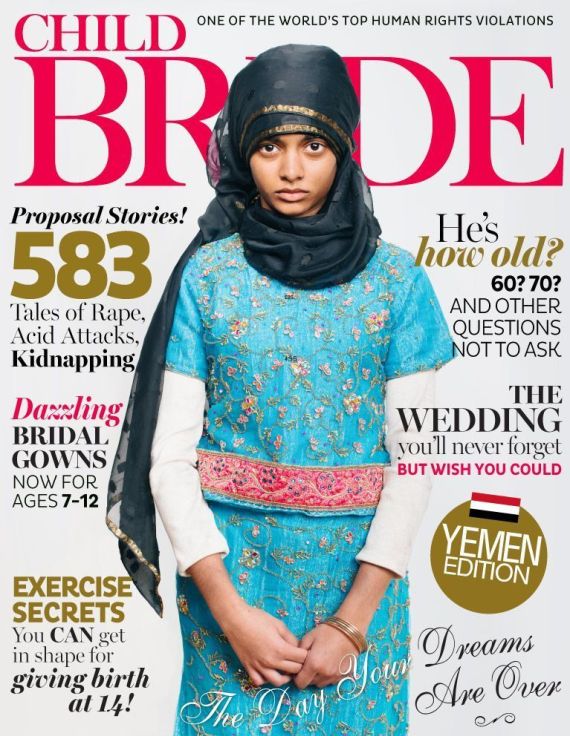
Child Brides Magazine
“The importance rests on the idea that mass media play a
role in structuring our understanding of reality and helping us make sense of
the world. This is particularly true when we as a community lack first-hand
knowledge.” (pg. 292).
The
quote is from the article on “First Impressions of Sarah Palin” that we read.
It particularly fits into the campaign that Catapult, a small non-profit organization,
is utilizing the covers of well-known and read magazines in the United States,
and changed the covers to reflect issues on Child Brides, Slaves and human
trafficking. The PR campaign has brought attention to the problems at hand in
time for the International Woman’s Day celebration.
I feel
like this is a particularly important issue, as we celebrate women around the
world. We need to protect our girls from
these horrific situations, and bring these issues to the forefront, just like
the women before us brought issues to the forefront for us. I believe, as a woman, that the constant
portrayal of women in the media, objectifying women, is an asset to this
campaign. It shows what the reality and
real life objectification of girls does around the world.
The
covers, like Child Brides, have captions like, “The wedding you’ll never
forget, but wish you could” or “Exercise secrets, you CAN get in shape for
giving birth, at 14” seem ridiculous in the context of American magazines, as
we turn a blind eye to these issues as a whole.
It makes the reader uncomfortable, which is the point. Make the person receiving this message
uncomfortable enough to act. Perhaps
then, we wouldn't need to use this tactic to encourage change.
Harp, Dustin, Loke, Jaime, & Bachmann, Ingrid.
(2010). First Impressions of Sarah
Palin: Pit Bulls, Politics, Gender Performance, and a Discursive Media
(Re)contextualization. Communication,
Culture & Critique 3 (2010) 291–309.
Monday, March 10, 2014
Sarah Palin, Six Years Later
During discussions
of gender performance in January we reviewed an article by Harp, Locke and
Bachmann analyzing the media representations of Sarah Palin. The study focused
specifically on media from major broadcast video segments during the first week
following the announcement of Palin to join John McCain’s ticket. Recent media attention,
and events, has brought Palin back to my attention. In looking at articles in
major newspapers, it is interesting to see some of the same motifs occurring
that were identified by Harp et. al.
As a bit of a
refresher, Palin’s emergence into the national spotlight was characterized by
three major themes according to Harp et. al.: the devoted mother, the beauty
queen, and the touch politician. The authors noted that Palin was presented
with an unusual combination of a “female’s politician’s toughness” with that of
an “ultra-feminine frame.” Palin received attention for both her physical looks
and her toughness (p. 304).
The Washington Post
reviewed her closing speech as the 2014 CPAC last week, article here. In this article, Palin is
presented as the tough counter to the liberal agenda under President Obama. Her
message to “hunker down and refuse to budge on conservative principles,” was a
combative contrast with that of other speakers including Christie, Ryan, and
Gingrich. Here, you see the toughness described by Harp et. al. coming out full
force. However, this article seems to lack the “ultra-feminine” frame when it
briefly discusses the conference’s focus, though not Palin’s, on how to attract
women and minorities to the conservative party.
An MSNBC article
similarly focused on Palin’s toughness during her CPAC speech, article here. Only briefly alluded to in the Washington Post
article, MSNBC focused more attention on Palin’s comments regarding women.
Unlike her first week of prominence, however, her comments and those of the
article focused mainly on her calls for the “sisterhood” to push other women to
fight for conservative ideals. Palin commented that women “know better than to
fall for that victimization line from the president and his party.” Here, even
in discussions of women’s rights, Palin is no longer being portrayed with the
“ultra-feminine frame.”
Additional articles
from Politico,
CNN,
and the Washington
Times all highlight Palin’s toughness and desires to fight the ideals of
Obama and the Democratic Party and/or Palin’s reactions and “told you so”
comments regarding the crisis in the Ukraine. A possible explanation is that
this is merely too small of a sample to compare with the data from hundreds of
clips that Harp et. al. reviewed. However, if this is a changed trend, how are
we to view this? Has media changed in the last six years? Are the first
impressions that Harp et. al. focused on not determinative of long term
perceptions? Have Palin’s actions herself allowed for a new perspective on her
as a politician?
Governor says, "It's time for the end of race in America. Now that would be progress."
The
coming presidential election has governors and other elected officials
jockeying to set forth on the quest to make a name for themselves. So
much so that I often detest even repeating the names themselves. And
perhaps that is fitting for the topic of an article written for Politico.com by
the governor of Louisiana. This
governor of East Indian descent puts forth the idea that citizens of the United
States ought to drop the hyphenation of their cultural identities, and simply
refer to themselves as ‘Americans’ no matter their ethnic divisions.
Personally, I see some value in this endeavor though I do not agree with the context of the statement (within a political campaign) nor do I agree with the more denigrating comments that this kind of public message stirs. Of course the question of whether we should continue to delineate between the various ethnic diversities of minority identities has important implications within our government and our society. First of all, removing the identifier that someone uses to describe themselves is as good as eliminating their identity altogether. Secondly, it is important for people, especially from the privileged and dominant portion of society, to understand the differences in people in order to understand their differences in opinion, wants, needs, desires, and in this case, perhaps even differences in the definition of the so-called ‘American Dream’.
However, creating certain differentiations can also have the opposite effect of creating round holes and square pegs by which many people do not fit into. We’ve discussed the identity gaps that certain individuals experience because of this feeling of in-between-ness. What do you think about the necessity or harm of delineating cultural identities along strict borderlines?
A lack of peace journalism
In examining
intercultural conflict, Oetzel, Dhar, and Krischbaum discussed the role of
media during an international conflict. One part that stood out to me regarded
the concept of peace journalism. Oetzel et. al. noted the many organizations
around the world dedicated to creating peace and resolving conflicts, but
questioned their ability truly have an impact on the policy level decision
makers. The authors highlighted the work of Jacobson and Jang who acknowledge “skeptic[ism]
about the ability to construct a strong public sphere without the support of
the media, which would need to change its philosophy toward social
responsibility.”
The concept that
journalists would change the way they report on events by abandoning an
impartial perspective is assuredly controversial. However, from my perspective,
I feel that it is one that is worth national media’s to explore. For a current
situation, reporting on the crisis in Ukraine provides examples worth
exploring.
An article in the
Washington Post from Saturday, “Ukraine on the line: Obama, Putin find little
common ground in telephone diplomacy,” discussed the conversations between
Presidents Putin and Obama last week. Click
here for article. As the title suggests, the article focuses on the lack of
agreement between the Russian and American positions. Towards the end of the
article, the author brings in comments from Putin that paint the United States
as a country that takes illegitimate actions around the world, just as Russia is
being accused. Though it is not an outright criticism of Obama as a weak leader
(just look at almost any Fox News report, or this Daily
Show segment for a more light hearted version), the article does very
little to move its reader base towards peace. Instead, it builds up the
inevitability of escalation for the conflict.
Granted, the
examples I have cited here are from conservative outlets that are more hawkish than
some other possibilities. While there may be some instances of peace journalism
attempting to change the philosophy of their reporting, as Jacobson and Jang
call for, they are not prevalent in mainstream news outlets. Instead, they are
calling Obama weak and prodding him to step up his response. They are
emphasizing discord between parties. Focusing only on the conflict occurring,
and how it may grow. As such, I would argue that this line of reporting is
itself biased. If this is a result of impartial journalism, than can we really
say that impartiality necessarily leads to balance? Do we not want to see a
humanizing account of what is going on, something that focuses on the
possibilities for resolution instead of escalation?
Oetzel, J., Dhar,
S., & Kirschbaum, K. (2007). Intercultural conflict from a multilevel
perspective: Trends, possibilities and future directions, Journal of Intercultural Communication Research, 36(3), pp.
183-204.
Sunday, March 9, 2014
Because who is perfect?
'Disabled' Mannequins Remind Us That Beautiful Doesn't Mean 'Perfect' (VIDEO)
http://www.huffingtonpost.com/2013/12/03/disabled-mannequins-video_n_4379586.html
Pro Infirmis is an organization for disabled people. The video shows the whole process that a number of mannequins are created based on real people with disability. It is very inspiring. The video reminds me of the discussion we had during class about the disabled culture and how media representation shapes people's thinking towards disable people.
In China, the media representation about people with disability both physical and mental is very narrow-minded. It always indicates that the disabled community is an inferior community to "normal" people. People with disability are describe as "imperfect"and "misfortune". However, seriously, who is perfect? What are the standards of "perfectness"? Who gets the say to set those standards?
Constantly, Chinese media associates "disability" with "helpless" and never with "beauty". It never brings up the idea that beautiful does not require for perfectness and people with disability are as beautiful as or even more beautiful than people without disability. In the future, media should focused on promoting the beauty and equality of people with disability. Let people embrace the idea that people with disability are not just about "misfortune" and "helpless".
At the end of the day, let people ask themselves: "who is perfect"?
Thursday, March 6, 2014
Are we now embracing gay bashers?
As none
of you probably know, Isiah Washington, the actor, is set to guest star and
return to Grey’s Anatomy in May of this year.
What is most interesting is that Isiah Washington was actually fired
from Grey’s Anatomy seven years ago. Here is the story behind this.
Grey’s
Anatomy is a drama television show written and created by Shonda Rhimes. Ms.
Rhimes has one of the most successful television shows on air at the present
time, and has won numerous Emmy’s for the television show. Additionally, she is praised for creating a
show with extensive interracial dating, and highlighting minorities as lead
characters. Oh, and Ms. Rhimes is also
African American. These factors have created an open space for tackling intercultural
interaction upon the show.
Back in
2009, Mr. Isiah Washington made an anti-gay remark on set referencing or
offending T.R. Knight, another actor on the show who happens to be gay. Isiah Washington apologized for the remark,
and then proceeded to follow up that remark with another one at the Emmy’s that
year. Ms. Rhimes decided to let Mr.
Washington go at the end of that season.
It is
no wonder that the media would be questioning why Ms. Rhimes has a sudden
change of heart. Seven years after the incident, she has decided to bring Mr.
Washington back to Grey’s Anatomy. While
those who follow the show will appreciate the appearance because it ties up Ms.
Yang’s story line quite nicely due to her exit at the end of this season, it
further asks why Ms. Rhimes is comfortable with having him back on the show,
seven years later.
The
show has a cultural overlap, as Halualani et al. explains in their
article. The cultural overlap would be
one that the television show is representative of minority rights, including
gay rights. However, it is also part of the American cultural narrative. These
overlaps are problematic, as Ms. Rhimes needs to be able to represent these
groups within the American (white dominant) narrative.
Could
it be that Ms. Rhimes doesn’t need to deal with the anti-gay remarks since
there are no openly homosexual men on cast this season? Or perhaps because she
wants to be able to please her audience? What about her loyalty to the LGBT and
other minority communities? Does Ms. Rhimes have an obligation to them?
Source: "Critical" junctures in
intercultural communication studies by Halualani, Mendoza & Drzewiecka
Subscribe to:
Posts (Atom)